
How EMFs Affect Pets: What Dog, Cat, Bird, Fish & Reptile Owners Should Know
March 17th 2026
Introduction: The Hidden Environment Your Pets Live In
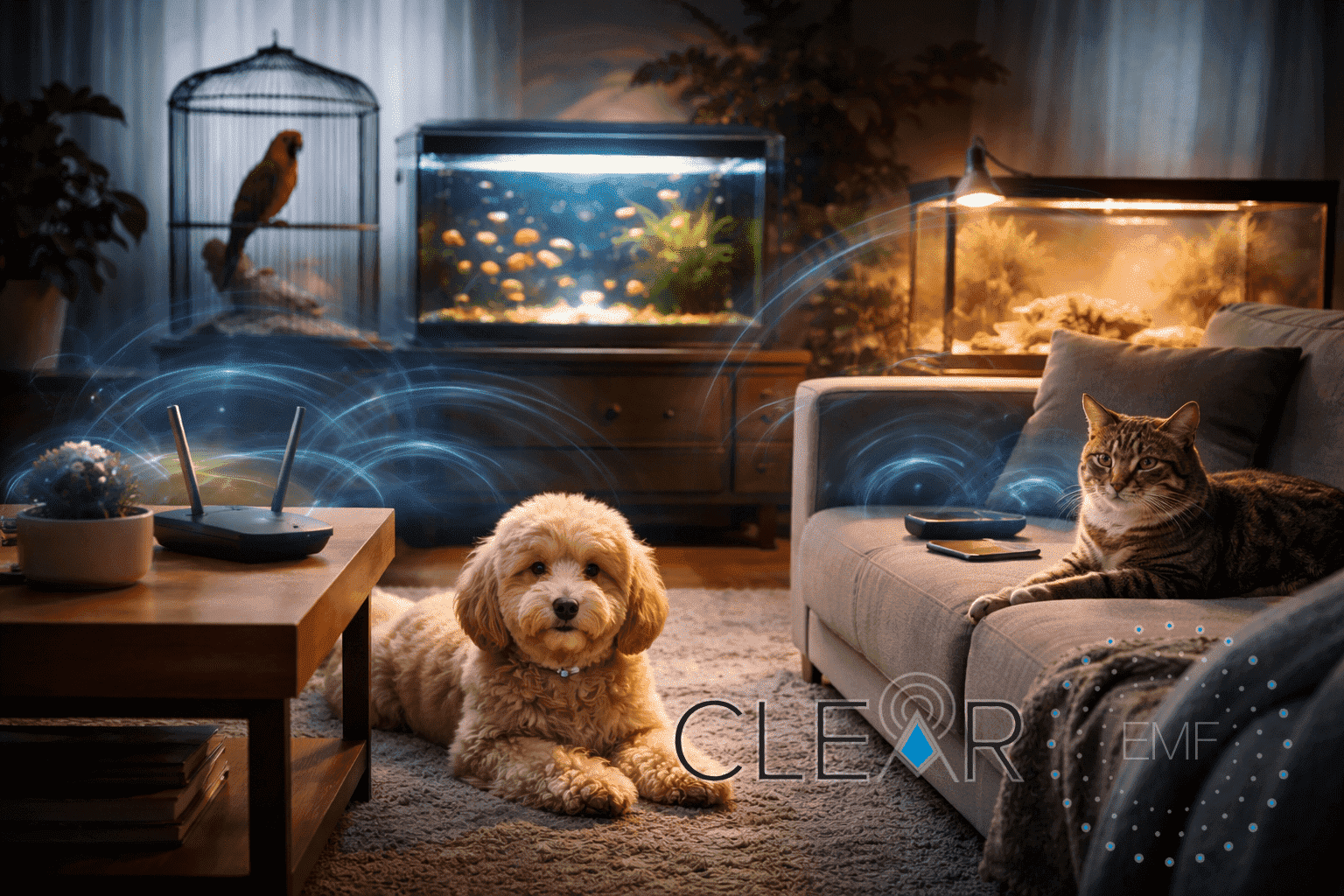
Modern homes are filled with invisible electromagnetic activity. WiFi routers, Bluetooth devices, smart home systems, tablets, phones, and constantly connected electronics all emit electromagnetic fields. While most EMF discussions focus on people, household pets experience this environment in a very different way.
Dogs, cats, birds, fish, and reptiles spend most of their time inside the home, often resting close to the same devices for hours at a time. Unlike humans, they cannot evaluate exposure sources or choose lower-exposure spaces on their own. They depend entirely on the environment we create around them.
That is one reason more homeowners are beginning to ask a broader question: if EMFs matter enough to measure for adults, what about the animals that sleep lower to the floor, rest near powered equipment, and live in the same wireless environment all day long?
At Clear EMF, we take a practical approach. The goal is not panic. It is awareness, measurement, and reducing unnecessary exposure where it makes sense. If your pet spends a great deal of time near routers, smart devices, aquarium equipment, reptile lighting, or electrically dense areas of the home, it is worth understanding what that environment actually looks like.
Section 1: Why Pets May Be More Sensitive to EMFs
Pets are not just smaller versions of adult humans. Their bodies, behaviors, and daily routines create a different relationship to the electromagnetic environment around them.
First, size matters. Smaller bodies mean that nearby sources may affect a greater proportion of the body relative to overall body mass. Pets also tend to spend more time in a fixed location, whether that is a dog bed beside a router, a cat on the back of a couch near a smart speaker, a bird cage near household electronics, or a reptile enclosure surrounded by powered accessories.
Second, pets often live closer to the floor and closer to outlets, cords, power strips, heating devices, lamps, and equipment clusters. In many homes, the strongest electrical activity is not at standing adult height. It is lower, near walls, floors, corners, entertainment centers, offices, and charging zones where pets frequently rest.
Third, some animals may be more environmentally sensitive in general. Birds are a major example. Many species are believed to rely on Earth’s magnetic field as part of orientation and navigation, which is one reason bird owners are often especially interested in electromagnetic stress inside the home.
At the cellular level, EMF discussions often focus on oxidative stress, calcium signaling, and broader biological responses to long-term exposure. That area remains debated, but it is one reason many households prefer to reduce unnecessary EMF exposure for pets in the same way they try to reduce it for children.
Section 2: The Main EMF Sources Pets Are Exposed To Indoors
The average home now contains multiple EMF sources operating at the same time. For pets, the issue is often cumulative exposure rather than one dramatic source.
WiFi Routers
WiFi routers are one of the most obvious and consistent RF sources in a home. They often run continuously, day and night, and are commonly placed in central living areas where dogs and cats also spend the most time. If your pet bed sits close to a router, modem, mesh node, or smart-home hub, that is one of the first areas worth evaluating.
If you are concerned about wireless exposure in sleeping or resting areas, learn more about microwave radiation inspections and testing and browse WIFI router guard options.
Bluetooth Devices
Bluetooth may operate at lower power than some other wireless systems, but it is often used at very close range. Smart speakers, headphones, wearable devices, pet trackers, keyboards, and entertainment systems can add another layer of constant wireless communication inside the home.
Electrical Fields and Household Wiring
Not all relevant exposure is wireless. Electrical fields from wiring, cords, outlets, lamps, extension cords, and improperly grounded devices can also matter, especially in pet sleeping areas, along walls, and near powered furniture or electronics.
For households that want a deeper evaluation of room-by-room exposure, Clear EMF also offers electrical field testing and broader electromagnetic radiation inspection services.
Dirty Electricity
Dirty electricity is another part of the discussion many pet owners overlook. LED lighting, electronics, chargers, dimmers, and certain appliances can introduce high-frequency voltage transients onto household wiring. For pets sleeping near walls, outlets, plugged-in devices, or equipment-heavy areas, that may contribute to an electrically “busy” environment.
You can learn more about dirty electricity testing and explore dirty electricity filters if you want to reduce unnecessary electrical noise in key parts of the home.
Smart Home and Entertainment Clusters
Televisions, game consoles, streaming boxes, mesh WiFi nodes, wireless speakers, charging stations, tablets, and phones are often concentrated in the same rooms where pets lounge. One device by itself may not seem like much, but the combined environment can be far more active than people realize.
Section 3: How Different Pets May Respond
Dogs
Dogs usually spend large portions of the day in family rooms, offices, bedrooms, and entry areas where wireless and electrical devices are concentrated. Some owners notice that a dog avoids a specific corner, refuses to stay in one bed, or seems unusually restless in a heavily connected room. That does not prove EMFs are the cause, but it can justify measurement.
Dogs may also spend time directly against powered furniture, near baseboards with wiring, or beside charging stations and routers. For dogs with a bed or crate in one fixed location, that immediate area is often the most important place to test.
Cats
Cats are known for choosing warm electronics, routers, cable boxes, windowsills near smart devices, and elevated shelves close to powered equipment. Because they often rest exactly where electronics cluster, cats can unintentionally spend long periods in areas with elevated electrical or wireless activity.
If your cat repeatedly chooses one electronics-heavy zone, that does not necessarily mean the area is good for them. It may simply be warm, elevated, or quiet. Testing tells you more than assumptions.
Birds
Birds may be the animal group that raises the most concern in EMF-conscious homes. Many bird owners already pay close attention to air quality, cookware, fumes, lighting, noise, and stress. EMFs belong in that broader conversation because birds are widely regarded as magnetically sensitive animals.
If a bird cage sits near WiFi gear, smart speakers, router shelves, entertainment centers, cordless phone bases, or dense electrical wiring, reducing nearby wireless and electrical activity is a sensible step.
Aquariums and Fish
Aquariums introduce a different exposure pattern altogether. Fish tanks often involve filters, pumps, heaters, lighting systems, controllers, timers, and power strips, all clustered around water. Even before you add nearby WiFi or entertainment equipment, the setup may already create a more electrically active zone than the average room corner.
Because water, powered equipment, and tightly packed cords frequently coexist around aquariums, this is one of the most overlooked places for home EMF testing.
Reptiles
Reptile enclosures depend on highly controlled environments. Heat lamps, ceramic emitters, UVB fixtures, thermostats, timed lighting, tank heaters, humidifiers, and monitoring systems all make reptile spaces electrically dense. Add wireless devices nearby and the enclosure area can become even more complex.
Reptiles are already dependent on careful environmental control. That is exactly why some owners want to reduce the unnecessary variables around the enclosure, including avoidable EMF sources.
Section 4: Cellular-Level Concerns and Long-Term Exposure
One of the main reasons this topic resonates with pet owners is that the concern is not just immediate behavior. It is long-term, background exposure at the biological level.
In EMF conversations, people often discuss oxidative stress, voltage-gated calcium channel activity, sleep disruption, and other subtle biological effects. Not every study agrees, and public debate continues, but many households do not want to wait for perfect consensus before reducing clearly avoidable exposure around the animals they care about.
That logic is similar to how many parents think about children. A baby or toddler is smaller, still developing, and often treated with extra caution. Many EMF-conscious homeowners view pets in a similar way: they are biologically different from adults, often more exposed in fixed indoor environments, and less able to remove themselves from potential stressors.
Whether the concern is wireless microwave radiation, electrical fields, dirty electricity, or magnetic fields from wiring and equipment, the practical takeaway stays the same: identify strong sources, reduce what you can, and make sleeping and recovery spaces calmer.
Section 5: Signs Your Pet May Be Experiencing Environmental Stress
EMFs are only one possible environmental factor, so no single symptom should be treated as proof. Still, patterns matter.
A pet avoids one bed, corner, perch, or side of a room consistently
Restlessness appears strongest near electronics or certain walls
Sleep quality seems worse in one area and better in another
A bird becomes more agitated in a highly wired room
A reptile enclosure sits in a very dense cluster of powered devices
An aquarium area has excessive cords, controllers, and nearby wireless equipment
These signs can have many causes, including sound, vibration, heat, light, drafts, air quality, or stress. But if one area repeatedly seems “off,” it makes sense to test it rather than guess.
Section 6: Practical Ways to Reduce EMF Exposure for Pets
Move routers away from pet sleeping areas
A dog bed, cat tower, bird cage, reptile enclosure, or aquarium should not sit right beside a router, mesh node, or smart-home hub if you can avoid it.
Reduce unnecessary Bluetooth and wireless traffic
Turn off features you are not using. Wireless clutter adds up.
Hardwire where practical
Ethernet connections can reduce RF exposure in rooms where pets rest most often.
Reorganize powered equipment
Try not to stack routers, chargers, power strips, speakers, and smart devices directly beside cages, tanks, or pet beds.
Address dirty electricity and electrical-field issues
Bedrooms, living rooms, and offices are common focus areas, but pet zones deserve attention too. If you suspect electrical noise or poor layout around a pet area, consider a professional evaluation of dirty electricity, electrical fields, and broader EMF testing.
Create lower-EMF recovery spaces
Even if you cannot change the whole house, you can often create one calmer sleep zone for your pets. That can be a meaningful improvement.
Section 7: Helpful EMF Tools and Protection Products
Some pet owners want to start with measurement. Others want immediate ways to reduce wireless and electrical exposure in key areas. A balanced approach usually includes both.
📡 Shop Home EMF Meters on Amazon to scan pet sleeping areas, cages, wall zones, and rooms with wireless devices.
🧲 Shop Magnetic Field / Gauss Meters on Amazon to test low-frequency magnetic fields near wiring, aquarium equipment, and powered enclosures.
📶 Shop RF and WiFi Radiation Meters on Amazon for checking router areas, smart devices, and wireless hotspots.
🛡️ Browse Clear EMF Shielding Products for broader home protection options.
📡 See WIFI Router Guards if a router must remain in a pet-heavy room.
🔌 See Dirty Electricity Filters for electrically noisy areas.
🛏️ See Bed / Canopy Shielding for households building lower-exposure sleeping spaces.
Tools are useful, but they do not replace a professional inspection when you want a full picture of how wireless, electrical, magnetic, and dirty-electricity sources interact throughout the home.
Section 8: When Professional Testing Makes Sense
There is a point where generic advice is no longer enough. If your pet sleeps in one fixed area, if you have a bird room, aquarium wall, reptile room, home office with animals nearby, or a bedroom with routers and smart devices, professional testing can help identify what is actually happening in those spaces.
Clear EMF performs inspections for homes and businesses and evaluates major exposure categories including magnetic fields, microwave radiation, electrical fields, and dirty electricity. That kind of structured testing is often the fastest way to move from vague concern to useful answers.
If you want to understand the actual electromagnetic environment around your pets, not just internet theories, start with data. Learn more about our electromagnetic radiation inspections, microwave radiation testing, electrical field testing, and dirty electricity inspections.
FAQ: EMFs and Pets in the Home
Can EMFs affect pets more than adults?
Many pet owners believe so, especially because pets are smaller, spend more time in fixed indoor spaces, and often rest close to floors, outlets, electronics, and wireless devices. Even when the science is still debated, reducing unnecessary exposure is a practical choice.
Are dogs and cats exposed to WiFi and Bluetooth every day?
Yes. In most modern homes, dogs and cats are exposed to WiFi routers, Bluetooth devices, smart-home systems, phones, tablets, and other electronics daily. The larger issue is often long-term cumulative exposure in the places where they sleep and relax.
Why do bird owners worry more about EMFs?
Birds are commonly viewed as especially sensitive to their environment, and many species are believed to use Earth’s magnetic field for orientation. That makes bird owners more cautious about unnecessary EMF sources near cages and bird rooms.
What about fish tanks and reptile enclosures?
These setups often contain multiple powered devices in a compact area. Pumps, filters, heaters, lighting, thermostats, and timers can create a denser electrical environment than many people realize, especially when wireless devices are nearby too.
What is the best first step if I am concerned?
Start by moving routers and wireless hubs away from pet sleeping areas, reducing unnecessary device clutter, and measuring the space. A good meter can help, and a professional EMF inspection gives a far more complete picture.
Conclusion: Better Awareness Helps You Protect Every Living Thing in Your Home
Pets cannot choose their environment. They live in the spaces we design, power, connect, and fill with electronics. As homes become more wireless and more electrically complex, it makes sense to think beyond human exposure alone.
You do not need to become obsessive to make smart changes. Moving a router, reducing wireless clutter, cleaning up a powered enclosure area, or testing a room properly can all be meaningful steps. Awareness is what leads to better decisions.
If you care about your dog, cat, bird, aquarium, or reptile collection, the same basic principle applies: reduce what you can, measure what matters, and create calmer recovery spaces wherever possible.
Schedule a Professional Clear EMF Inspection
Clear EMF provides professional EMF testing for homes, businesses, pet rooms, sleeping areas, and other indoor spaces where hidden exposure may be a concern. If you want to identify stronger EMF zones around your pets and get practical guidance on what to change, contact Clear EMF today.
We use measurement-based testing and practical recommendations to help households better understand magnetic fields, microwave radiation, electrical fields, and dirty electricity throughout the home.