Can You Trust a Viral EMF Meter Video? Five Details to Check Before You Share It
A clip that ends on a jumped number establishes almost nothing on its own. Five checks tell you whether it establishes anything at all.
Imagine a clip, because you have seen one: an EMF meter beeps, the camera zooms in on the screen, a number jumps to something alarming, and the video ends on that number. The honest answer to “can you trust it?” is that the clip, on its own, establishes almost nothing. The number is a value in a unit we have not seen, taken at a distance we have not been shown, against a background we have not measured, from a device in a mode we have not identified, captured once. Each of those five gaps can be closed by looking at the same thirty seconds more carefully, and the rest of this article is how.
Pause on That Frame
So pause on that frame, the one the editor chose as the ending, and ask the question the clip never asks: what does this number actually say? An EMF display is a small report, and like any report it has a subject, a scale, and a context. The subject: which field, magnetic, electric, or radiofrequency, is the meter in the mode to see? The scale: what unit is the number in, and on what range? The context: where is the sensor, what else is in the room, and is this reading repeated or a single spike? The clip gives you the drama of a number. The interpretation requires the three things it left off camera.
The Five Checks
Five details, in the order they most often change the interpretation. None of them requires expertise; all of them require the video to have filmed the thing, which is usually the problem.
1. The meter’s mode, and which field it is actually seeing
Most consumer “EMF” meters are multi-mode devices, and each mode sees a different physical quantity. A magnetic-field mode sees current-carrying wiring and motors; an electric-field mode sees voltage-carrying conductors and insulation; an RF mode sees radio transmitters like routers and phones. A desk fan is a magnetic-field story, a motor with current in it; a router is an RF story. If the clip never shows the mode, the number has no subject, and a fan-shaped spike on the wrong screen is not a finding. This is the check that most often inverts a viral conclusion, because the alarm was set for a different field than the one the demonstrator meant to measure.
2. The displayed units, and the scale
The next section does the arithmetic, but the principle here is the one that matters: the number on the screen is only a number in a unit, and the unit is not always the unit you assumed. The same physical field prints different digits in different unit systems, and the same digit in two different units is two different fields. A clip that shows the screen is giving you the number; it is usually not giving you the unit, and the unit is where the factor-of-ten surprises live.
3. The sensor’s distance and orientation
Field strength falls off with distance, often steeply, and for magnetic fields it also depends on how the sensor is oriented relative to the source. The difference between the face of a fan motor and a point three feet from it can be an order of magnitude, and the difference between the sensor’s best orientation and its worst can be a factor of two or more. A number without a stated distance and orientation is a number from an unknown place, and “unknown place” is not a location in the room where you are worried.
4. The background reading, and what else is in the room
Every room has a baseline: wiring in the walls, a lamp, a charger, the phone doing the filming, the meter’s own noise floor. The demonstrator who never shows the room with the source off has not separated the source from the room, and the “spike” may be the room. The single most informative thirty seconds in any measurement video is the one where the scene is exactly as it will be during the test, except that the source is off, and the meter is already running.
5. Whether the observation repeats over time
One frame is an event; a pattern is a result. Meters have peak-hold functions that freeze a momentary spike, and they have alarm thresholds that make a crossing look like a level, and both are useful in the right hands and misleading in the wrong ones. The check is simple: does the reading hold, return, or repeat when the source is switched on and off, and over a span of minutes rather than a single pass? A reading that does not survive a second look is not a measurement yet.
One Field, Two Unit Systems
Here is the arithmetic that saves or sinks cross-video comparisons, as a labeled illustration rather than a measurement: take a single magnetic field of 0.2 microtesla (µT). In the other common unit system, the same field is 2.0 milligauss (mG), because 1 µT equals 10 mG. The field did nothing; the unit system changed the digits by a factor of ten. Now hold that in your head while comparing two videos: one meter reading “0.2” and another reading “2” may be describing the identical field, and the more alarming number is the one in the smaller unit.
Now the RF screens, where the comparison breaks down entirely. An RF reading in volts per meter and a magnetic-field reading in microtesla are different physical quantities, and a “15” on one and a “15” on the other share no common meaning at all. They are not two views of the same field; they are two different fields. Any cross-device or cross-video argument that treats those numbers as comparable has confused the subject, and the argument collapses at the first unit check.
| What the clip shows | What you still need to know |
|---|---|
| The meter beeps | Which mode is active, and what alarm threshold produced the beep |
| A number on the screen | The unit, the scale, and whether it is a peak-hold or a live reading |
| The sensor near a device | The distance, the orientation, and whether that distance is where you actually are |
| A spike with the source on | The background reading from the same scene with the source off |
| One dramatic moment | Whether it repeats, over time, in the same conditions |
| A claim about the device | Whether the measured field is attributable to that device at all, versus the room |
How to Film a Fair Demonstration
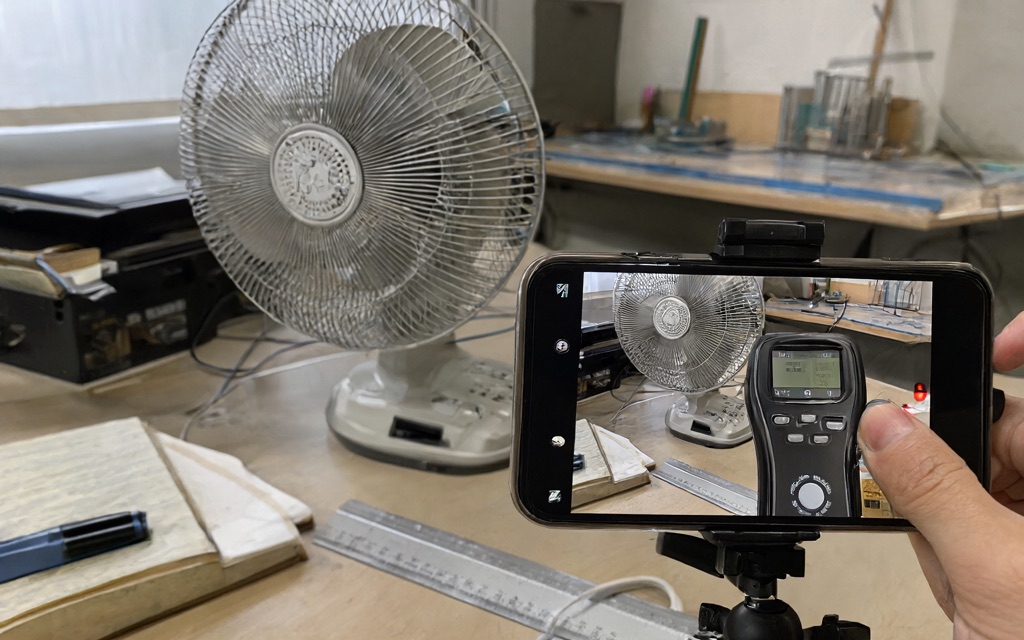
The good news is that a fair version of the same clip is cheap to make, and the script below is the whole thing. It uses an ordinary household device, a desk fan, the kind of source the photo above shows on a workbench, and the discipline is entirely in what the camera includes.
- Film the whole scene first. The room, the desk, the fan, the meter, and everything else that is plugged in, with the fan off and the meter running, for thirty seconds. This is the baseline, and it is the frame the viral clips never show.
- Show the meter’s mode and units on camera. A ten-second close-up of the screen before anything switches on, so the subject and the scale are established before the number moves.
- State the distance, then keep it. “Sensor at three feet” or “sensor at six inches,” said out loud, and then the sensor stays where it was put. Moving it mid-test is a new experiment.
- Switch the source on, and let the reading settle. No zoom on the jump; let the screen be seen for a full minute so the reading’s behavior, steady, settling, or spiking, is part of the record.
- Switch it off again, and show the return. The reading returning to the baseline is the confirmation that the baseline, not the room, was the cause.
- Repeat it three times. Three on/off cycles, same positions. Repetition is the difference between an event and a result, and it costs ninety seconds.
That is the entire protocol, and it is the same discipline a professional applies with a better instrument: matched conditions, a recorded baseline, a stated distance, and repetition. The viral clip and the fair clip can be filmed from the same desk; the difference is whether the context was on camera.
The Question to Post Under the Clip
If you want to share a clip without insulting its creator, or to test one before you amplify it, there is one question that does most of the work, because it asks for the context rather than the conclusion:
“Cool clip! What mode was the meter in, what were the units, and what was the reading in the same room before the fan was on?”
It is friendly, it is specific, and it asks for exactly the three facts that decide the interpretation. A demonstrator who can answer all three has a measurement. One who cannot has a clip, and now the audience knows the difference, which is more than the original thirty seconds gave them. For the reading side of this whole business, our guide to what a high meter reading actually means goes deeper, and our piece on checking the claims on phone radiation stickers applies the same five checks to a product instead of a video.
Sources
The unit conversion used above is a fixed relationship between the two standard scales for magnetic field: 1 microtesla equals 10 milligauss. Meter-mode and threshold behavior described here is general to consumer multi-function meters; specific models should be checked against their own documentation for mode ranges and alarm settings.
Common questions
Frequently asked questions
Because the number on an EMF display is a value in a unit, and the units differ by screen and by model. A "15" on a magnetic-field screen and a "15" on an RF screen are measurements of different physical quantities with different scales and different meanings; there is no common interpretation that carries across them. Even within magnetic-field meters, the same physical field can display as microtesla or milligauss, and the two unit systems differ by a factor of ten, so the digits are not directly comparable between videos.
They are two names for the same magnetic-field quantity on different scales: 1 microtesla equals 10 milligauss. A field of 0.2 microtesla displays as 2.0 milligauss. The field did not change; the unit system did. That factor of ten is why a clip from one meter and a clip from another, both "high," can be describing the same modest field.
A beep is a threshold, not a measurement. The meter is telling you the reading crossed a line, and that line is a setting, often a default the demonstrator never showed. A device that beeps is useful for finding that something is there; it is not, by itself, a record of how much, in what units, from what source, or for how long. Treat the beep as the start of an investigation, not the conclusion of one.
Close enough to be interested is usually inches, because many household fields fall off steeply with distance. A reading at the surface of a device motor and a reading three feet away can differ by an order of magnitude, and the two numbers describe different places. The distance the sensor sits from the source is therefore one of the five checks, and a clip that never shows the distance has left out the variable that most changes the number.
It shows the setup, the mode, the distance, the baseline, and the repetition, in that order of importance: the whole scene before the source is powered on; the meter’s mode and units visible; the distance stated or shown; a background reading from the same room with nothing on; and the observation repeated enough times that one spike is not the story. A clip that omits all five is a mood piece, and a fair version of the same thirty seconds is usually available to anyone willing to film it.