Do Anti-Radiation Phone Stickers Work? How to Check the Claim Before You Buy
The sticker costs less than a coffee. The claim costs more than that. Here is how to read what you are actually being asked to believe.
A shopper is being asked to believe one specific thing: that a small adhesive patch, pressed to the back of a phone, makes its radiation safer. The honest first answer is that it depends entirely on which version of the claim you are reading, and most sellers do not define the outcome that would prove it. Some products claim to reduce the radiation a phone emits, a measurable statement. Others claim to “neutralize” or “harmonize” it, a statement no meter can test. The difference is the entire ballgame, and the checklist below is how you tell the two apart before paying.
The Claim You Are Being Asked to Believe
Strip away the packaging language and the claim is a chain of three links: the phone produces electromagnetic radiation (true), the patch changes something about that radiation (unproven, and it depends), and the change is a health benefit (unproven, and it is not what the product measures even if link two were true). Each link is where a seller can quietly move the goalposts, so each link is worth checking separately.
Link one is real. A phone in normal use transmits radiofrequency, or RF, energy from its antenna, and the power it uses varies with the network. Links two and three are where the product lives or dies.
Two Kinds of Stickers: Reduce versus Neutralize
The first kind makes a measurable claim: the patch reduces the RF the phone emits, by some percentage. If that is the claim, then a defined test exists in principle, and the seller can be asked to show it. The question to ask is the one that splits honest sellers from the rest: what outcome, measured how, would count as evidence for this claim, and have you defined it?
The second kind makes a non-measurable claim: the patch “neutralizes,” “balances,” or “harmonizes” the radiation. Read carefully, these words describe a change in a property of the radiation that no instrument measures and no standard defines. The radiation level goes up, stays the same, or goes down, and the “safety” story is unaffected. If the level is unchanged, the product has done nothing a measurement can see, and the benefit is asserted, not demonstrated. That is not a skeptical stance; it is the definition of the claim. A product whose central effect is unmeasurable cannot be checked, and a consumer cannot verify a purchase whose promise has no test.
Regulatory context sharpens the point. Federal consumer guidance on cell phone radiation has, in various forms, told shoppers that there is no established need for such protection products, and U.S. guidance on product claims generally puts the burden on the seller to substantiate health-related statements. In practice, that burden lands on the buyer, who is expected to spot the unmeasurable claim in a listing photo.
What Would Count as Evidence
For the “reduces” claim, the evidentiary bar is a controlled comparison under matched conditions: the same phone, in the same network state, at the same distance and position, measured the same way, with and without the patch, repeated enough times that one lucky dip is not the result. A defensible version of that test has five elements, and a seller who can document all five in writing has given you a review you can actually use:
- The exact claim under test, quoted, with the defined outcome that would confirm or refute it.
- The phone and its state: model, carrier, signal strength, and whether it is calling, transferring data, or idle, because the phone’s transmit power changes with all of those.
- The meter and its limits: model, usable frequency range (a meter that does not cover the phone’s band cannot see it at all), units, and where the sensor sits relative to the antenna.
- Positioning and distance, fixed and stated, for every trial.
- Repeated trials, with a control, ideally an inert patch of the same size, to separate the sticker’s effect from the act of placing a square of material on the phone.
None of those elements appears in most of the product listings we have seen, and that absence is itself the finding: a product in a category full of untestable claims, with no defined test, is a product whose value is a matter of faith. That is a buyer’s checklist away from a decision, which is what the rest of this article is.
Why Casual Demonstrations Mislead
The most common “proof” in this category is a short demonstration: a phone held near a meter, a number on the screen, a sticker applied, a lower number, conclusion. Three things make that demonstration unreliable, and all three are ordinary physics rather than seller bad faith.
The phone changes its own output. A phone adjusts its transmit power continuously to hold its connection to the tower. Move it, change your hand’s grip, or let the signal waver, and the power changes on its own, independent of any sticker. A before-and-after number pair from a hand-held phone is measuring the network as much as the product.
The path matters more than the source. The meter reads whatever reaches its sensor: the phone, the hand, a case, a table, the demonstrator’s body. A sticker that changes the radiation’s direction, even while the total stays the same, can lower the reading at one spot and raise it at another. A single vantage point cannot tell those apart.
The meter has a range and a threshold. A handheld meter only sees the frequency bands it is built for, and it has a lowest readable level. If the phone is on a band the meter covers only weakly, or the level is near the meter’s floor, the “change” the display shows may be the meter’s own noise and rounding, not the product’s effect.
None of this means a sticker can never be shown to change a reading. It means a casual demonstration cannot be trusted as a measurement, and a measurement that is not a controlled test is not evidence of the claim. A handheld reading is also not a laboratory SAR measurement, which is a different, standardized quantity, and even a perfect demonstration of “the level went down” would not be proof of a health benefit. The claim chain has three links, and the demonstration tests one of them.
A Buyer’s Checklist for Reading the Claim
Print this out. Every question has a good and a bad answer, and a listing that fails any of them is a product whose value you are buying on faith.
- “Reduce” or “neutralize”? Good: a specific, measurable statement. Bad: “neutralizes,” “harmonizes,” “balances” — effects no meter measures.
- Is the outcome defined? Good: “X% reduction at Y cm, measured with Z.” Bad: “makes radiation safer,” with no X, Y, or Z.
- Is there a control? Good: the seller shows the inert-patch comparison, or at least the setup. Bad: product shots only.
- Are the conditions stated? Good: phone model, network state, distance, meter model and band, units, trial count. Bad: a single graph with unlabeled axes.
- Is the test independent? Good: a third party named, or a reproducible protocol. Bad: the seller’s own photo.
- Is a mechanism offered? Good: a physical account of how the patch interacts with the signal, that a physicist would recognize. Bad: “technology” and “frequency” used as decoration.
- What is the return policy? Good: a real one. A product whose effect is unmeasurable should at least be refundable if it disappoints you.
The Test We Would Run
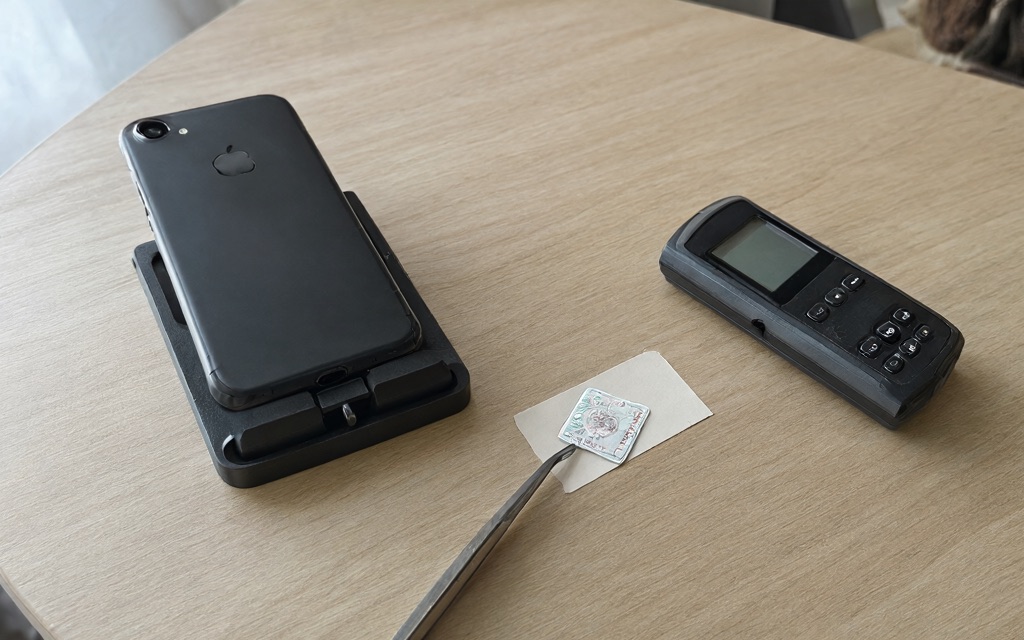
The setup in the photo above is the shape of the test we would run if we sat down with one of these products, and we are labeling it as a proposed test, not a completed one: no results from it are reported in this article. The protocol would document the exact claim under test, the phone model and its network state for each trial, the meter model and its usable frequency range, a fixed cradle position and distance, the units displayed, and a run of repeated trials with an inert control patch, good and bad network days included. The interesting result is the one nobody in this category seems eager to produce: a small, real, inconsistent, and directionally noisy number, with the honest note that a changed level is not a proven health benefit.
If you have already bought a sticker, the same setup lets you check it yourself, and the guide to reading a high meter reading will keep the interpretation honest. And if your interest is broader than one product, our companion piece on protection stickers and pendants covers the whole category. The simplest exposure changes remain the ones with the best physics: distance, and airplane mode.
Sources
- Federal Trade Commission consumer guidance on cell phone radiation, and on the substantiation of product health claims.
- Federal Communications Commission guidance on radiofrequency exposure and on accessory claims.
Common questions
Frequently asked questions
In principle, a sufficiently conductive patch placed over the phone’s antenna region can absorb or re-radiate some of the signal, and a before-and-after measurement at a fixed distance could show a reduction. Whether a given product does that, by how much, and consistently, is exactly what a controlled test would measure. The issue with most products on the market is that no one has published a controlled result, and the "percent reduction" on the listing is a number the seller chose to print.
It means the product is not making a measurable claim. "Neutralize" and "harmonize" describe a change in a property of the radiation that no meter measures and no standard defines. If the radiation level is unchanged, the sticker has done nothing a measurement can see, and the "safety" is a quality the buyer cannot check. That is the clearest red flag in this product category.
There are two changes with a far better evidence-to-effort ratio than a sticker: distance and airplane mode. RF falls off quickly with distance, so a phone across the room or in another room is a smaller exposure than a phone in your hand, and airplane mode removes the radio transmissions entirely. If you want to know what your phone actually contributes where you sit, a measurement at your real locations tells you whether the question is worth the worry at all.
Ask the five questions the graph should contain: the meter model and its usable frequency range, the phone and its network state, the fixed distance and position, the units, and the number of repeated trials. A graph with no axis labels, no stated conditions, or a single dramatic dip is a picture, not a measurement. Sellers who can answer all five in writing are rare in this category, and their answers are the product review.
No. A lab SAR measurement uses a standardized phantom, a defined phone configuration, and certification procedures; it characterizes absorbed energy under controlled conditions. A handheld meter at an arbitrary distance reads a field level, which is a different quantity, on a different scale, and only as good as the setup around it. A meter can show that a sticker changed something. It cannot show that the change is a health benefit.