Can Someone See Through Your Walls With Wi-Fi?
The viral video shows a ghostly outline where a person should be. The research behind it is real. The surveillance implied by the headline is not.
The question the video seems to pose is a simple one: could someone, with a typical home router, watch the people inside a house the way a camera would? The straight answer is no. The research behind those viral clips is real and peer-reviewed, but it is a controlled experiment that produced a blurry, low-resolution map of motion using purpose-built hardware and software, demonstrated under laboratory conditions. It is not a capability of consumer routers, and it is not a picture of a person in the way a camera makes one. The distance between those two statements is the whole article.
The Viral Video Claim
The clips usually run the same way: a room, a wall, and a display showing a ghostly outline, a person’s silhouette, moving as if the wall were glass. The narration supplies the word “camera” or “Wi-Fi vision,” and the clip ends on the outline. What the clip does not show, because it would not fit in thirty seconds, is everything that stood between the radio signal and that outline: the specific hardware, the specific signal processing, the specific conditions, and the specific gap between the output and a photograph.
Pausing the clip and asking what is actually being displayed is where the honest version of this story begins.
One Documented System, Traced End to End
One well-documented system from 2017, known as Wi-Vi, is a good example to trace, because it is widely reused in these viral clips and its own publication is unusually explicit about what it did and did not show.
The hardware. The system used ordinary commercial Wi-Fi hardware, specifically a class of consumer network adapters, in a non-ordinary arrangement: one unit transmitting and another receiving, with the receiving unit running software to extract detailed signal data that stock firmware does not expose. So the answer to “did it use ordinary Wi-Fi?” is the precise one: commodity hardware, modified and paired for a measurement purpose, with a specialized analysis chain on the receiving side. It was not a neighbor’s router, and it was not off-the-shelf software.
What was measured. The receiver recorded the channel state of the Wi-Fi signal, essentially a detailed record of how the signal’s strength and phase changed across a set of frequency channels as it traveled through the space and bounced off what was in it. A person moving in the room scatters and absorbs part of that signal, and the record of those changes is a set of numbers. No image exists yet at this step. The image is what the next step invents, in a technical sense.
What the software inferred. An analysis algorithm, working from those numbers, reconstructed a low-resolution, grayscale-like depiction of the moving person, at a rate the authors described as comparable to video frame rates. The depicted thing is the outline of motion: where the body was, how it shifted. It has none of the content of a photograph. No face, no clothing, no detail. A person watching the output recognizes a moving shape, the way you recognize a person in fog from the shape and motion of the form, not from any feature of it.
The conditions. The demonstration took place in a controlled setting: a defined room, a wall between the hardware and the subject, a person moving within it, and a normal camera recording the same events. The camera recording was there for two standard scientific reasons: to validate the radio reconstruction against ground truth, and to supply labeled data for the algorithms. The honest description, then, is: the radio system’s reconstruction was checked against a camera’s picture, not that the radio system produced a picture.
Each of those four steps, hardware, measurement, inference, conditions, is narrower than the viral headline by which the clip is famous. Nothing in the published work describes a consumer product, a neighbor’s network, or a living room under surveillance.
When a Headline Says ‘See,’ What Does It Mean?
“Seeing” with radio is a ladder, and the rungs are genuinely different capabilities. A headline that says “see” can be sitting on any of them, and the difference between the bottom and the top is the difference between a useful feature and a camera.
| Rung | What it means | Typical hardware | Does a consumer device do this? |
|---|---|---|---|
| Presence detection | Someone is in the space, or not | Coarse radio sensing; radar in many modern devices | Yes, in some products, as an optional feature |
| Motion detection | Someone moved, and roughly where | Radio or radar sensing with more analysis | Some, coarsely; settings-dependent |
| Pose estimation | A skeleton of the body’s major positions | Purpose-built sensing and trained algorithms | Rarely, and only in marketed forms of it |
| Camera-quality imagery | Detail: faces, clothing, objects | A camera | Only if you bought a camera |
Everything in the research we traced above sits between the second and third rungs, in a laboratory, with purpose-built equipment. The viral outline is a motion depiction, not an image. The rung it is not on, camera-quality detail, requires a camera, and no radio system in the consumer market produces it.
What a Lab Result Does Not Establish
Three boundaries keep the research honest, and they are worth stating plainly because the viral version erases all of them.
A demonstrated capability in a lab is not a deployed capability in homes. The system required hardware in a particular arrangement, a particular analysis chain, and a subject who was present and moving in a defined space. A neighbor’s router, running stock firmware, performing its ordinary job of delivering your video call, is not running that experiment. The research shows what the technique can do when someone builds it. It does not show that someone has built it, aimed it at your house, or that a consumer product does.
The output is not what the narration calls it. The reconstruction is a depiction of motion at a resolution that would be unrecognizable at a glance, validated against a camera that was physically present in the experiment. Calling it “Wi-Fi seeing through walls” compresses four distinct steps, signal, numbers, algorithm, conditions, into one word, and the word is doing the work the evidence is not doing.
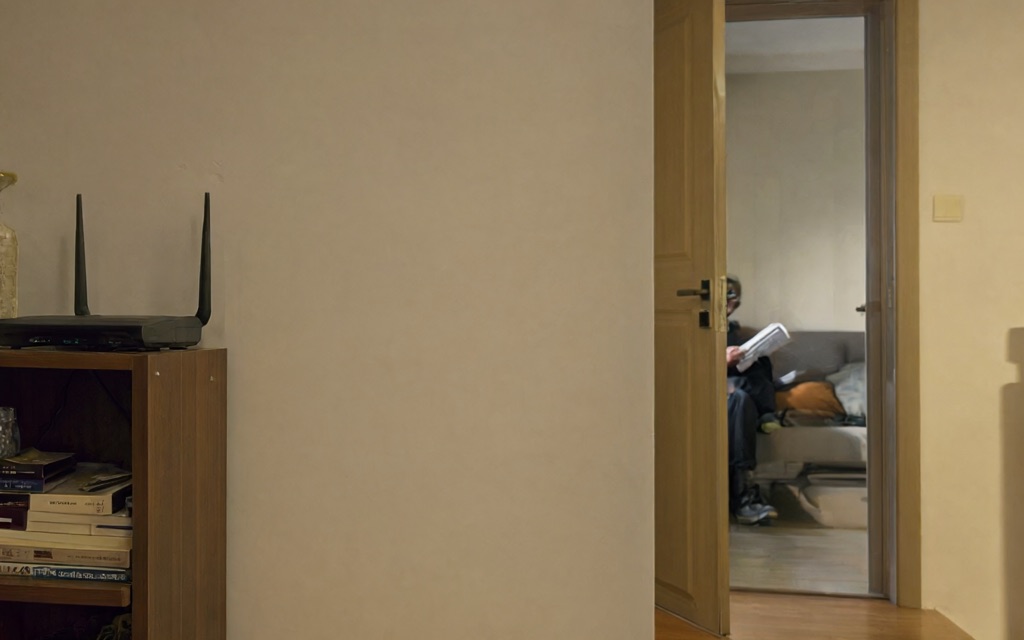
Signal passage is not the claim. It is true that Wi-Fi passes through walls, which is why placement matters and why our guides on routers versus mesh systems talk about where the radio actually reaches. Attenuation, the signal arriving weaker, is a property everyone’s home already has. It is not a lens, and the gap between “the signal gets through” and “the image gets through” is the gap between physics and the viral headline.
Privacy Questions You Can Ask About Products You Own
The productive version of this anxiety points at the products you actually have, because several consumer categories now include sensing features of the lower rungs. A short list of questions works on almost any of them:
- What does this feature measure? Presence, motion, or something finer? The product’s own documentation will name the rung.
- Where does the data go? Processed on the device, or sent to a cloud? “On-device” is a materially different privacy fact than “in the app’s cloud.”
- Is it on by default? And can it be turned off completely, per room or per device?
- What happens when I update the product’s software? Sensing features have a history of arriving via updates; a periodic look at the settings is reasonable maintenance.
- Do I actually want this in this room? A sleeping room and a nursery are the two spaces where “convenience” and “sensing” compete hardest. Turning the feature off there costs nothing and removes the question.
Those questions keep the discussion where it belongs: at the level of product settings and consumer privacy, where a person can actually act. They also do what the viral clip cannot: they point at features you can find in a menu tonight, rather than at a ghostly outline that requires a research lab to exist.
The One-Sentence Answer
Here is the clearest single sentence the research supports: a 2017 laboratory system used modified consumer Wi-Fi hardware to reconstruct a blurry outline of a person’s motion behind a wall, and no consumer router, as sold and configured, can watch a home the way a camera does. The signal passes through your walls. The camera does not live in them. For the everyday question of whether your own Wi-Fi reaches every room, and what that means for the devices in them, our companion guide to reducing bedroom EMF exposure covers the measurement side of the same walls.
Sources
- The 2017 Wi-Vi research paper (peer-reviewed; exact venue and author list to be confirmed and cited before publishing).
- Product documentation for the specific consumer devices in question, for their sensing features and data handling.
Common questions
Frequently asked questions
No, not with an ordinary router running its normal firmware. The demonstrated research used purpose-built hardware and analysis software to reconstruct motion in a controlled lab setting. A consumer router, as sold and as configured, does not run that analysis and does not produce that output. The signal physically passes through walls in both directions, which is a different and much smaller question than imaging.
It is a description of how a radio signal changed on its way from transmitter to receiver: its strength and phase across a set of frequency channels. When a person moves in the room, they scatter and absorb part of that signal, and the pattern of change is what the software works with. It is a set of numbers, not an image. The image is a reconstruction the algorithm makes from those numbers, and the reconstruction is only as good as the assumptions the algorithm was trained with.
Not as cameras. Some consumer products offer “presence” or “activity” sensing, where the device detects that someone is present or moving in a space, and a few can infer coarse motion. That is the presence-detection rung of the ladder below, a far cry from imagery, and the settings for those features are usually in the product’s app. If a product markets sensing, read its privacy documentation and turn the feature off if you do not want it.
Yes, in the way the field uses cameras: to record what actually happened, so the reconstruction produced by the radio system could be checked against it, and to supply labeled training data for the algorithms. That is standard scientific validation, and it is also why the honest description is “the radio system’s output was compared with a camera’s picture,” not “the radio system took a picture.”
Yes, which is the small true kernel under the headline. Radiofrequency energy attenuates as it passes through building materials, and that is why router placement matters and why a second floor can still reach the first. Attenuation, the signal arriving weaker on the other side, is not imaging, and the distance between the two ideas is the entire difference between the research and the viral claim.